
Looking for puppy training West Bloomfield pet parents actually trust? Every walk turns into a tug-of-war. Your puppy lunges at a squirrel, drags you toward another dog, and by the time you get home your arm is sore and your puppy is still wound up. It feels like a training failure. It is usually something much simpler: nobody has ever taught your puppy what a loose leash actually feels like.
Quick Answer: Puppies pull on the leash because pulling gets them where they want to go faster, and nobody has shown them a better way. It is not defiance and it is not a bad puppy. It is an untaught skill that gets more rehearsed, and harder to unlearn, the longer it goes uncorrected. Force-free training paired with a walker who reinforces loose-leash manners on every visit is how most West Bloomfield puppies break the habit in a matter of weeks.
Here is why the pulling happens, and what actually fixes it.
Why Puppies Pull in the First Place
From a puppy’s point of view, pulling works. They lean into the leash, the leash gives a little, and they get closer to the smell, the dog, or the person they wanted to reach. That single reward, closer to the thing, teaches the behavior faster than almost anything a person can say. The puppy is not being stubborn. They are doing exactly what worked the last ten times they tried it. This is basic operant conditioning: whatever gets rewarded gets repeated, whether or not anyone intended to reward it.
The habit compounds with age. A 12-week-old puppy pulling at eight pounds is annoying. The same behavior at nine months and sixty pounds is a real problem, and by then it has been rehearsed hundreds of times. That is why West Bloomfield families who catch it early save themselves months of frustration later.
The Signs Leash Pulling Is Becoming a Habit, Not a Phase
Some pulling is normal for a young dog exploring the world. It becomes a pattern worth addressing when you notice a few things stacking up: your puppy leans into the leash the moment it goes on, before you have even left the driveway. Walks get shorter because your arm or shoulder is tired before your puppy is. You have started avoiding certain streets, times of day, or other dogs because the pulling gets worse around them. Redirecting with a treat used to work and does not anymore. Your puppy checks back with you less on walks than they did a month ago, a sign the leash itself, not you, has become the thing they are focused on.
None of these mean your puppy is broken. They mean the current approach has run its course, and it is time for a different one.
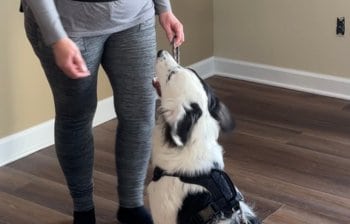
What Puppy Training West Bloomfield Force-Free Trainers Use Actually Looks Like
Force-free training does not mean permissive. It means the puppy learns loose-leash walking is the thing that gets rewarded, not the thing that gets punished out of them. In practice that looks like stopping the moment the leash goes tight, rewarding the instant it goes slack again, and teaching your puppy that a loose leash, not a tight one, is what makes the walk continue. No prong collars, no shock collars, no choke chains, no alpha rollovers. Becky Lea, our founder, is CPDT-KA and Certified Shelter Dog Trainer; Megan, our trainer, is a certified obedience trainer, and both teach this exact method in-home in West Bloomfield.
Humane World for Animals notes the same core approach for loose-leash walking: reward the behavior you want instead of correcting the one you do not, and keep sessions short and consistent so the new habit actually sticks.
Picture a typical West Bloomfield household two weeks into force-free training: the first few walks still end with a sore arm, then somewhere around day ten the leash starts staying slack for longer stretches between corrections. That timeline lines up with what trainers see most often, not a coincidence. Humane World for Animals notes that reward-based training builds new habits faster than correction-based methods, precisely because the dog is working toward something instead of avoiding something, which is also why the trainers certified by the Certification Council for Professional Dog Trainers, the body behind Becky’s CPDT-KA credential, teach consistency across every walk, not just training sessions.
Why Your Walker Matters as Much as Your Trainer
A training session once a week teaches the skill. It does not build the habit on its own, because a puppy who only practices loose-leash walking for thirty minutes and then pulls the rest of the week is relearning the old pattern faster than the new one. This is what we mean when we say we train humans to train their dogs: sometimes the missing piece is not another lesson, it is consistent reinforcement between lessons.
Every walker on our team is trained on force-free handling, which means the exact loose-leash cues Becky or Megan teach in a session are the same ones your puppy practices on every midday walk in between. A puppy who gets that kind of daily repetition typically shows real, visible progress in four to six weeks, not four to six months.
What to Do This Week If Your Puppy Is Pulling
Start with shorter, more frequent walks rather than one long one, since a tired arm gives up on training faster than a tired puppy gives up on pulling. Stop the instant the leash tightens and wait for slack before moving again, every single time, even when it feels slow. Bring high-value treats and reward loose-leash moments generously, especially in the first two weeks. And if the pulling is intense, sudden, or paired with lunging at people or other dogs, that is worth a trainer’s eyes sooner rather than later, in-home, before the habit gets more rehearsed.
Consistency across everyone who walks your puppy matters just as much as the method itself. If one family member stops at every tight leash and another lets the puppy drag them to the next tree, the puppy gets two conflicting sets of rules and learns neither one reliably. Before you start, agree as a household on the same response every time, and make sure anyone else who walks your puppy, a family member, a friend, or a professional walker, is using that same approach.
What Happens If You Wait It Out
Some families decide to wait and see if the pulling improves on its own as the puppy matures. Occasionally it does. More often, the behavior simply gets stronger, because every successful pull is another repetition of the same lesson: pulling gets results. A sixty-pound adolescent who has pulled successfully for a year is a much harder training case than a twelve-week-old puppy on day one, and the walks in between are harder on your body the whole time you wait. Starting early is not about urgency for its own sake. It is about training the habit before it has months of practice behind it.
Frequently Asked Questions About Puppy Leash Training in West Bloomfield
Q: Why does my puppy pull so hard on the leash?
A: Pulling works from the puppy’s point of view: leaning into the leash gets them closer to whatever they want faster, and that reward teaches the behavior quickly. It is not defiance. It is an untaught skill that gets more rehearsed the longer it goes unaddressed. The behavior is learned within the first few walks a puppy takes on a leash, often before an owner realizes training is even needed yet.
Q: At what age should I start leash training my puppy?
A: As early as possible, ideally the first week your puppy comes home. Habits formed at eight weeks are far easier to shape than habits rehearsed for a year, and force-free methods work at any age, including with adult dogs who never learned loose-leash manners as puppies.
Q: Do you offer in-home puppy training in West Bloomfield, MI?
A: Yes. We provide in-home force-free dog training in West Bloomfield, including puppy leash manners. Becky Lea, our founder, is CPDT-KA and Certified Shelter Dog Trainer; Megan, our trainer, is a certified obedience trainer. Most puppies show real leash progress in four to six sessions. Sessions happen in your West Bloomfield home, not a facility, so your puppy practices in the environment where the pulling actually happens.
Q: Will a dog walker help with leash training or make it worse?
A: A walker trained on force-free handling helps significantly, because they reinforce the same loose-leash cues your trainer teaches, on every walk in between sessions. An untrained walker who lets a puppy pull can undo that progress just as easily, which is why every Paws Around Motown walker trains on the same protocols our trainers use.
Q: How long does it take to stop a puppy from pulling on the leash?
A: Most puppies show visible improvement in four to six weeks with consistent, force-free training reinforced on daily walks. Puppies who only practice the skill once a week in a training session, with no reinforcement in between, typically take much longer. Puppies who start training under four months old typically progress fastest, though force-free methods work at any age.
Q: What equipment should I use for leash training a puppy?
A: A front-clip harness is usually the easiest starting point for force-free leash training, since it gives you gentle steering without any pressure on your puppy’s neck. Flat collars work too once loose-leash manners are established. We recommend avoiding retractable leashes during training, since the constant give-and-take teaches the opposite of what you want. Your trainer can recommend specific gear at your first in-home session.
Ready for Puppy Training West Bloomfield Families Recommend?
Leash pulling is not a bad puppy problem. It is a teaching gap, and it is fixable. See how we combine in-home force-free training with reinforcing midday walks on our Dog Walking and Dog Training in West Bloomfield page, or book a free meet-and-greet and we will build a plan around your actual puppy. Looking for help with exercise too? See how a midday dog walker in West Bloomfield reinforces this same training between sessions.
About the Author: Becky Lea is the founder of Paws Around Motown and a Certified Professional Dog Trainer (CPDT-KA) and Certified Shelter Dog Trainer serving West Bloomfield and Oakland County since 2014. She specializes in reactive and rescue dogs and leads a team that is Pet First Aid and CPR certified.